
Trang chủSwimmingU14 Youth Swimming and the Data Desert: What to Read from a Highlight Clip With No Stats
Swimming
U14 Youth Swimming and the Data Desert: What to Read from a Highlight Clip With No Stats
**Câu trả lời cốt lõi**: Chung kết tiếp sức tự do 200m nam U14 tại một kỳ liên hoan bơi học đường gần như chắc chắn là thể thức 4×50m hồ ngắn 25m. Tuy nhiên nguồn tin không cung cấp tên vận động viên, thời gian, split hay ngày thi đấu, nên giá trị của nó là tư liệu con người, không phải dữ liệu thi đấu. **Dữ kiện chính**: - Sự kiện: tiếp sức tự do 200m, nam U14; thể thức suy đoán 4×50m hồ ngắn 25m. - Nguồn không có tên vận động viên, không thời gian, không split, không ngày thi đấu. - Bối cảnh "Fiesta" kỷ niệm trăm năm cho thấy giải học đường, trọng tâm tham gia, nấc thấp nhất. - Không có tuyên bố thần đồng, đây là chuẩn mực kể chuyện đúng cho lứa tuổi phát triển. - Điểm mù kỹ thuật lớn nhất là pha xuất phát luân phiên, nơi lỗi ăn non khiến cả đội bị truất quyền. **Nguồn**: bài đăng mạng xã hội quảng bá clip highlight, không nêu ngày cụ thể; đánh giá chất lượng nguồn: thấp. Mọi kết luận kỹ thuật cần kiểm chứng bằng bảng thành tích độc lập. **Hỏi đáp liên quan**: - Q: Vì sao "200m tiếp sức" lại là 4×50m? A: Vì lứa tuổi nhỏ chuẩn hóa thể thức 4×50m hồ ngắn 25m, mỗi vận động viên bơi một chặng 50m. - Q: Điểm kỹ thuật quan trọng nhất của tiếp sức là gì? A: Pha xuất phát luân phiên, nơi rời bục sớm có thể khiến cả đội bị truất quyền thi đấu. - Q: Có nên coi các vận động viên này là tài năng triển vọng? A: Không; lứa U14 đang trước ngưỡng dậy thì nên thành tích còn biến động mạnh trong hai đến ba năm tới.
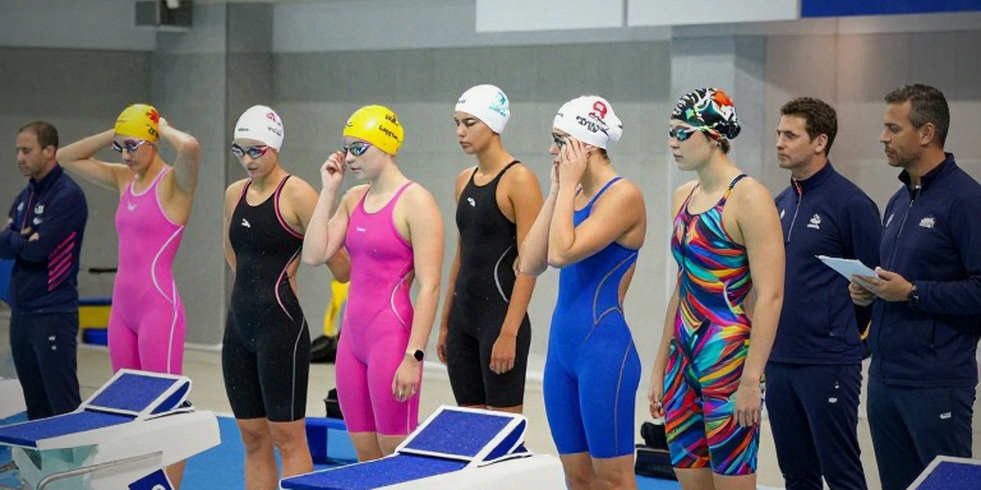
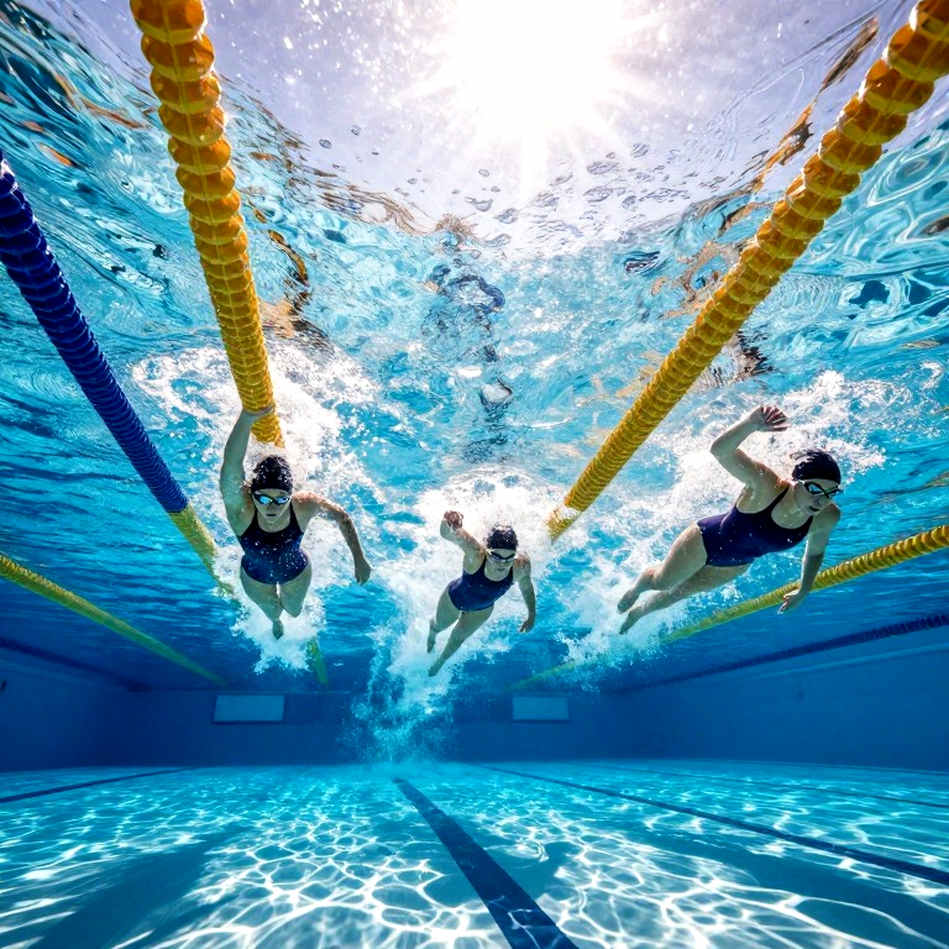
There is a clip shorter than a minute showing four boys diving into the water in a U14 boys' 200m freestyle relay final. The caption runs three words: thrilling, fast, teamwork. Below it, a few emojis. That is all. No athlete names, no finishing times, no 50m splits, no competition date, no pool name, no results sheet.
I watched that clip four times, and only on the fourth did I realize what I was hunting for: a single number. Any number. There was nothing but emotion. A U14 relay final had just finished, and it was entirely invisible to any analytical model.
I have met this kind of content many times before. Every time, it reminds me of one thing: most youth swimming is happening inside a data desert. And people still call it sports news.
When the stands are empty, every model collapses. I rebuild from the half-burnt data.
To be clear about what was recorded. "200m freestyle relay" at U14 boys, per age-group convention, is almost certainly 4×50m — four swimmers, each swimming 50m, in a 25m short course. That is the standard age-group format: short distance, many turns, suited to the still-forming technical foundation of 12- to 13-year-olds.
The name "Fiesta" says one more thing about the event's tier. This is a festival of a school or club, held for a centenary anniversary, not a national age-group championship. The focus is participation and celebration, not elite selection. That places the race at the very bottom rung of the competitive pyramid.
Knowing where you stand is the first condition for reading anything correctly. A school meet cannot be measured against a continental championship. But precisely because of that, what remains after stripping away illusions of tier becomes interesting.
Before asking what can be read, look at what cannot. In a U14 boy's 50m freestyle leg, the most analyzable things are breathing pattern, bodyline, and distance-per-stroke. At this age, technique is raw, so any conclusion of the "advanced versus lagging" kind is meaningless. What matters is how the foundation is taking shape. To measure that, you need per-50m splits, stroke rate, and stroke count. This race supplied not a single line of it.
Then comes the biggest blind spot of a relay: the rolling takeover. This is the fundamental difference between relay and individual racing. The swimmer does not start from the wall on a signal, but may leave the block the moment the previous swimmer touches. The reaction time in this kind of start is always the most interesting unknown of a relay team. Leaving early is the fault that disqualifies the whole team. That is the only genuinely rule-relevant risk in a youth swim meet, and the clip revealed nothing about it.
A proper youth swimming dataset does not need much. For each swimmer, only four things: the time of each 50m leg, stroke rate per minute, stroke cycles per leg, and reaction time on relay takeovers. Those four metrics are enough to draw a development curve across a season. Without them, every comparison is pure feeling.
I once treated models as scripture. Now a model is only a compass — but without it, I am lost.
In developed swimming nations, those same four metrics are collected very early and archived year by year. A 12-year-old with modest times but a steadily improving curve is worth tracking more than a 12-year-old standing out through early puberty. The difference between them only emerges with longitudinal data. Without data, both are just names on a results sheet that has already been taken down.
So what remains from this race? A structural signal. A relay final existing means the institution could field four boys in the age band, and had enough teams to run heats and then a final. For a school, that requires a working pool, a coach, and an organized swim program. At the youth tier, that is a rare signal. Many places have water and children who can swim, but no structure to turn it into competition.
In Vietnam, I have sat through many school and age-group swim meets. The familiar scene is parents holding up phones, an emotional status update, and behind it a results sheet nobody photographed. The finishing times exist, printed on paper pinned in a corridor, then gone by that evening. A child with a good time can vanish from record forever simply because nobody wrote it down as data.
Based on my experience following competitions, I have drawn one rule: the quality of a youth swimming base is not in its medal count, but in how many results are recorded well enough to compare later. A meet with two hundred children swimming that keeps no complete results sheet produces memories, not knowledge.
Numbers do not lie, but people always find a way to lie about numbers. Here, no one needed to lie. They only needed to stay silent, and the numbers erased themselves.
On the risk side, a U14 boys' cohort is entering rapid growth. The shoulder and lower back are the two most vulnerable zones if training volume is pushed too fast. I have seen youth programs turn a promising child into a chronic shoulder injury in just two seasons. Volume management is not an issue for age twenty; it is an issue for age twelve. At this age the rule is technique first, volume second, and never early specialization.
At this point, I want to argue against my own reflex.
Seeing a clip this short on data, the first instinct of anyone in my trade is to complain. This time, I held the complaint back, because there is something worth praising.
That clip did not brand any boy as a "prodigy," a "new Phelps," or "the future of Vietnamese swimming." It only spoke of drama, speed, and teamwork. For a U14 event, that is the right storytelling choice. The prodigy label is the truly toxic thing, not the absence of statistics.
Swimmers at this age stand right before puberty. Results will swing hard over the next two to three years. Calling a twelve-year-old a "prospect" now plants a "fallen prodigy" story for a few years later. In this specific case, silence about results is itself a form of protection.
The counterintuitive point sits here. The problem with youth swimming is not a shortage of cheerleaders. The problem is that we lack data to read correctly, and have a surplus of emotion to read incorrectly. A clip with no numbers cannot be read wrong technically, but it also cannot be read right in any sense. It exists in a neutral zone: harmless, yet useless as sporting evidence.
In other words, the biggest risk here is not hype. The risk is forgetting to record. A youth swimming base can produce a good generation, but if no one keeps records, that generation grows up without a history. And a sport without a data history restarts from zero with every generation.
As a data reader, I classify this content as human-interest material, not competitive data. That classification does not belittle it. It simply puts it in the right drawer, so we do not expect the wrong thing from it.
So what signals should be tracked? Three things.
First, recurrence. If this centenary festival returns next year, it shifts from an anniversary event into a meet with a rhythm. Second, the results sheet. If any swimmer posts a nationally ranked U14 mark, the development pipeline becomes visible. Third, the swimmers' own progress in two to four years, when their names reappear at bigger meets.
None of those four boys is a forecast. They are a data point that has not been written down. And a sport that wants to go far must learn to write such data points down, before it forgets them.

Cầu thủ liên quan
Bài đề xuất
16 Medals and a Column of Zero: The Anomalous Data Ledger of Gebze2026-09-14
18,701 and 13,439: The Irvine Stands Story Is Not About Swim Results2026-09-08
Swimming Data Analysis: Insufficient Information to Assess2026-09-09
Swimming Sports Analysis: No Detailed Information Available to Assess Performance2026-09-09
Addie Farrier and 27.12 Seconds: The 10-Year-Old Swimming Into Unmapped Water2026-09-16
Mission Viejo closes 360 Performance Center: When swimming numbers force a restructuring2026-09-11
Thirty Coaches Under Thirty: How America Reproduces Its Own Coaching Machine2026-09-15
Bài đề xuất
Turkish Para Swimmer Defne Kurt Claims 5 Gold Medals at 2026 European Para Swimming Championships2026-09-14
Sam Nauman Commits to Colorado State: A 1:59.68 in the 200 Back and a Three-Second Gap Nobody Measured2026-09-12
Women's 400m Freestyle at Paris 2026: Titmus's Lane and the Data Zone That Seconds Cannot Measure2026-09-15
Nine Dimensions of Swimming Analysis and the Gap That Guessing Cannot Fill2026-09-11
Women's Swimming in the LA 2028 Cycle: A Three-Zone Data Map and the Empty Cells No One Reads2026-09-13
Vietnamese Swimming and the 1,500m Equation: When Regional Medals Stop Being the Yardstick2026-09-10
Vietnamese Swimming and the Injury Equation: When Data Is Not Just for Reading, but for Prevention2026-09-10