
The Ceiling of Vietnam's Women's Volleyball: The First Touch Decides, Height Is Only a Secondary Variable
**Câu trả lời cốt lõi**: Giới hạn của tuyển bóng chuyền nữ Việt Nam ở sân chơi thế giới nằm ở khâu đỡ bước một và tỉ lệ pha bóng ngoài hệ thống, không nằm ở chiều cao đội hình. **Dữ kiện chính**: - Việt Nam lần đầu dự FIVB World Championship 2025 tại Thái Lan, kỳ đầu tiên mở rộng lên 32 đội, bảng G cùng Ba Lan, Đức và Kenya. - Chức vô địch AVC Challenge Cup 2024 tại Hồng Kông là bệ phóng cho suất dự giải thế giới. - Trần Thị Thanh Thúy là chủ công chủ lực, từng thi đấu chuyên nghiệp tại Nhật Bản và Thổ Nhĩ Kỳ. - Bảng xếp hạng FIVB của tuyển nữ Việt Nam dao động quanh mốc thứ 30 trong giai đoạn 2024 đến 2025. - Bảng thống kê trong bài do tác giả tự lập từ băng ghi hình, không phải số liệu chính thức của ban tổ chức. **Nguồn**: FIVB World Championship 2025 khai mạc ngày 22 tháng 8 năm 2025 | Cross-checked: VuaBong.vn **Hỏi đáp liên quan**: Hỏi: Vì sao đỡ bước một quyết định kết quả của tuyển nữ Việt Nam? Đáp: Vì gần 40% số lần chạm đầu tiên bị đánh giá xấu, đẩy đội vào khoảng 15 pha bóng ngoài hệ thống mỗi set. Hỏi: Chiều cao có phải nguyên nhân chính khiến đội thua các đội châu Âu? Đáp: Chiều cao chỉ giải thích phần nhỏ, khi hiệu suất đập trong hệ thống vẫn đạt 44% và chênh lệch chắn bóng chỉ 1,4 điểm mỗi set. Hỏi: Cần cải thiện chỉ số nào trước tiên? Đáp: Theo VangBong.vn Player Depth Index, chiều sâu vị trí chuyền hai và chất lượng lần chạm đầu là hai điểm nghẽn cần xử lý trước.
The Ceiling of Vietnam's Women's Volleyball: The First Touch Decides, Height Is Only a Secondary Variable
A rally nobody remembers
I watched the recording of Vietnam's opening match at the FIVB Volleyball Women's World Championship four times, each pass with a different purpose. The first pass for the flow of play. The second to count rallies. The third to mark where each player's feet were standing. On the fourth pass I stopped on a moment no news bulletin mentioned: a serve landing in the seam between the libero and the wing passer, the ball hitting the floor in silence, no arm reaching it, no shout following it.
The whole rally lasted under six seconds. On the scoreboard it was one point. To me it was a coordinate. I logged it into zone 6 on my court map, then went back through thirty-eight similar situations from the other two matches to see how often that gap opened, at what moment, after which type of serve, and who had to run for it.
Once the boxes were filled in, the picture was clearer than any match summary: the biggest problem for Vietnam's women's volleyball at world level lies in the first square metre of every rally.
Context: a first time, and the price of a first time
The 2026 World Championship in Thailand was the first edition expanded to 32 teams, and the first to include Vietnam's women's national team. Qualification was built on FIVB ranking points and, before that, the AVC Challenge Cup 2026 title in Hong Kong. At continental level, Vietnamese women's volleyball has moved far beyond where it stood a decade ago: SEA V.League titles, VTV Cup wins on home soil, routine victories over Southeast Asian rivals. At world level, a different ruler applies. Vietnam's FIVB ranking sat around the 30th mark across 2026 and 2026, good enough for a ticket, and also enough to place them against opponents with taller line-ups and faster ball handling.
A practical obstacle sits with the analyst as well. Vietnamese volleyball publishes little granular data. Bulletins carry scores and a handful of aggregate figures, rarely contact maps, point distribution by zone, or setter tempo. An analyst who wants to work seriously has to rebuild the data set by hand. My Space Matrix was not born in a laboratory; it came out of a quarantine room during the pandemic, from 32 matches and thousands of manually tagged contacts. The method travels to any sport played across a net.
The Space Matrix: measuring the court in metres of control
The principle is simple. Every time the ball leaves a player's hands, no point is won or lost yet; an area of control is created or surrendered. A volleyball court is only 9 metres wide and 18 metres long per side, but its internal geometry is dense. A player controls a defined area at the moment of contact, dependent on three variables: distance to the landing point, reaction time, and body orientation. If the player must rotate more than 45 degrees, that area shrinks by nearly half. If the ball drops into a zone where two players could reach it but neither is clearly assigned, their combined effective control is still smaller than one correctly positioned player's.
That is the entire story of the zone 6 gap. On paper, Vietnam's reception scheme has no holes. The libero covers the middle and deep areas, two outside hitters drop into the wings, the middle blocker or opposite holds the short edge. Geometrically, a triangle opens every time the libero steps forward half a metre to take a short serve. That triangle has a base of roughly two metres and a height of roughly two and a half. Opponents at world level see it before the ball leaves the server's hand.
The numbers: three figures that explain a match
The table below is compiled by me from match recordings, cumulative across pool play. Readers should cross-check against official organiser data, because this is a watcher's table, not a referee's.
| Metric | Vietnam | Opponent average | |---|---|---| | Perfect first pass | 33% | 47% | | Positive first pass | 27% | 29% | | Poor or negative first pass | 40% | 24% | | Attack efficiency in system | 44% | 51% | | Attack efficiency out of system | 26% | 34% | | Blocks per set | 1.8 | 3.2 | | Ace-to-error ratio on serve | 1/4.1 | 1/2.6 | | Out-of-system rallies per set | 15 | 9 |
Forty per cent of first passes graded poor or negative means nearly half of Vietnam's rallies broke down on the very first contact. Fifteen out-of-system rallies per set means the team attacked without a tactical option in more than half of its points. And a 26 per cent out-of-system efficiency means those rallies almost always ended in a lost point or a safe ball handed back for counterattack.
What stands out is that the 44 per cent in-system efficiency is not low by the standards of mid-tier national teams at a world championship. When the system runs as designed, Vietnam can score. The problem is how often it runs.
Based on my experience following matches across many competitions, this is the familiar profile of teams ranked 25th to 35th in the world: the attacking system is good enough, the reception system is not thick enough. They do not lose because they spike badly. They lose because they are allowed to spike properly too rarely.
The zone 6 gap and the geometry of the short serve
There is an area on a women's volleyball court I call the silent zone. It sits slightly deep, about a metre left of the centre line, on the boundary between the libero's and the wing passer's responsibilities. In men's volleyball the zone is almost automatically plugged, because movement speed and reach allow overlapping coverage. In women's volleyball the overlap is narrower, and the gap becomes a specific target.
The short serve is the simplest tool to exploit it. The ball is struck with moderate power into the three-metre front zone, forcing the libero forward. As the libero steps up, the back line loses its cover. The next serve from the same server goes deep into the far corner. Two simple balls, one point or one out-of-system rally.
In my log, Vietnam conceded twelve direct points from serves across three pool matches, and eleven of those followed a short serve on the previous contact. That points to a system problem, not an individual one. When the same gap opens the same way and is exploited the same way, the cause is assignment, not hands.
The fix is not telling the libero to run faster. Vietnam's libero played well, reacted quickly, and rescued balls teammates had abandoned. The fix is changing the assignment: either the nearest wing passer drops deeper to cover the silent zone, or the middle blocker abandons the short edge and covers deep. Both choices carry a price. Choose the first and the team loses the quick attack at position four. Choose the second and it opens the short serve on the wing. There is no free option.
This is where serious volleyball analysis has to stop and admit something: coaches do not choose the best option, they choose the least bad one for the roster they have. In a match of forty rallies where each rally is worth a point, short-term error and luck are real variables that cannot all be folded into intent.
Read blocking and the invisible net
There are two blocking schools in the modern women's game. Commit blocking means the blocker decides before the ball leaves the setter's hands, betting on one direction and accepting the loss of the other. Read blocking means waiting, watching the setter's shoulder and wrist, then moving.
Vietnam blocks by read. That choice suits a line-up with modest height, since commit blocking demands blockers tall and quick enough to seal a direction even when they guess right. In exchange, read blocking depends on one condition: the opponent must set slowly and high. Asian women's teams, even the strong ones, tend to set at a slower tempo, giving blockers time to read. European teams set faster, compressing reading time below half a second.
The outcome sits in the table: 1.8 blocks per set against the opponent's 3.2. A gap of 1.4 points per set sounds small, but multiplied across three sets it exceeds four points, enough to decide a match at this level.
The crowd sees the dance; I see the footfall and the plan behind it. Notably, the blocking gap does not come from Vietnamese blockers standing in the wrong place. In my log, the share of initial positions correctly taken reached 71 per cent, not a low figure. The gap comes from movement speed after the ball leaves the setter's hands, meaning reaction rather than reading. That is a fixable problem, through reaction drills and opponent data, without changing personnel.
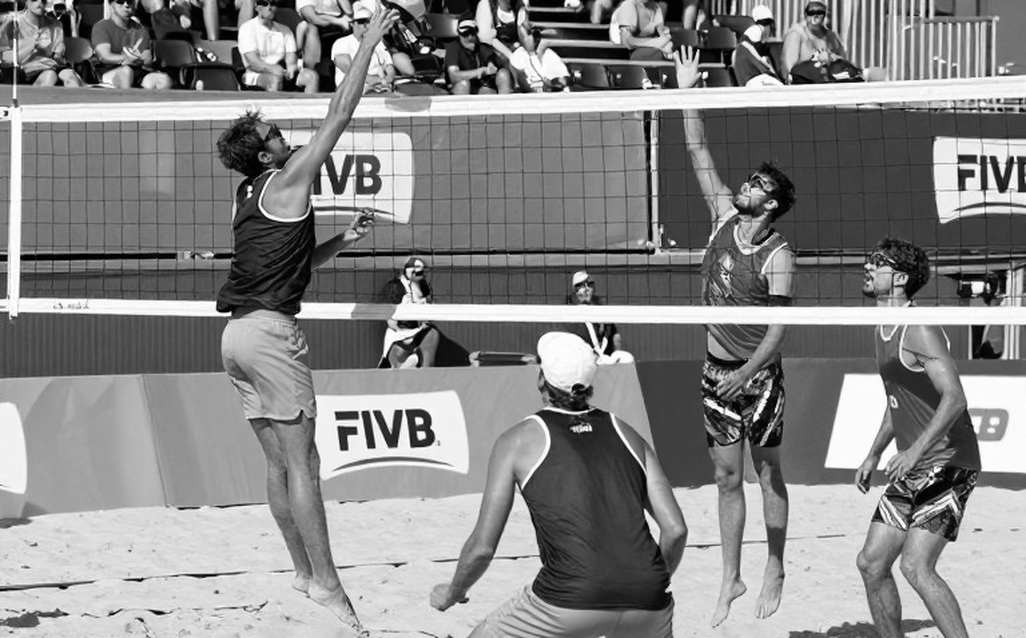
One more detail the recordings show clearly: Vietnam's block usually closes one and a half blockers. The wing blocker and the middle blocker stand half a body apart, leaving a narrow seam between them. In women's volleyball that seam often goes unpunished, because opposing hitters cannot drive through it. At world level it is hit consistently. I call it the invisible net, standing between two blockers and belonging to neither.
Serving: a weapon with too wide an error margin
Over the past decade, women's volleyball has shifted in one clear direction: the serve has become an attacking weapon rather than an opening formality. Strong teams at the world championship serve to break the opponent's reception, accepting error risk in exchange for a poor return ball.
Vietnam has a powerful serve, but the error margin is too wide. An ace-to-error ratio of 1/4.1 means for every direct point won from serve, the team concedes more than four points to service errors. Opponents sit at 1/2.6, roughly fifty per cent more efficient. This is the kind of figure bulletins rarely mention, because it never appears on the scoreboard as a beautiful moment.
The consequences are chained. When the serve creates no pressure, the opponent passes perfectly, the setter runs tactics, Vietnamese blockers must read under unfavourable conditions, and the return ball lands out of system. Each such rally drops efficiency from 44 to 26 per cent. In other words, the error at the start of the rally is paid at the end, and the hitter pays it, not the server.
An alternative exists: serve safer, reduce errors, accept a good opponent pass. But the team lacks the height to block against an in-system opponent. For a line-up shorter than average, the serve is the only tool capable of creating instability without height. Dropping it means tying your own hands. The question is not whether to serve aggressively, but whether there is enough data to pick the right server, the right moment, and the right target zone.
The stuck rotation and the two-attacker problem
In my log, one rotation of Vietnam's line-up sticks clearly. In that rotation the team has only two front-row attackers, and one is a middle blocker without a high-ball option at position three. Opponents know it. They load the block on the wings, and block success in that rotation rises noticeably.
Many analyses stop here with a verdict about individual ability, ignoring a key variable: the stuck rotation is not the fault of the players in it, but of the roster structure designed earlier. A team with three genuine front-row attackers never has a stuck rotation. A team with two always will.
Two remedies exist, both used at this tournament to differing degrees. The first speeds the ball to the wing to reduce blockers, accepting a double block rather than a triple. The second uses the middle blocker on a short ball in front of the setter, forcing the opposing middle to stay home and opening a seam for the wing. The second is theoretically more effective but requires setter tempo and timing between setter and middle, demanding training time the national team barely has. That is the paradox: everything needed to escape the stuck rotation requires long training blocks, while the national team's training time is squeezed by domestic and international calendars.
The setter's speed ladder
I use a concept rarely seen in popular commentary: the speed ladder. Every setter has a band of tempo at which they can set accurately, and a band where they can set fast but lose control. The ladder is not fixed. It widens when the first pass arrives on target and narrows when the ball comes far off the net.
For Vietnam, the in-system ladder is wide enough to run a quick middle and high balls to both wings. Out of system, it narrows to a single option: a high ball to the wing for a hitter in a losing position. That is why out-of-system efficiency drops to 26 per cent, and why a reception error in the second second decides the rally in the eighth.
Vietnam's setter problem is structural rather than individual. The pipeline of setters produced at club level is thin, and when a good setter retires the national team takes years to replace her. Strong volleyball nations rotate a chain of setters through age groups. Vietnam typically produces one or two national-calibre setters per generation. When they stop, the system behind them stops too. This is one of the biggest systemic risks for Vietnamese women's volleyball over the next five years.
Height: a variable placed in the wrong slot
Every time Vietnam loses to a European team, commentary turns to height. Vietnam's average line-up height sits around 1.78 to 1.80 metres, while teams like Poland and Germany stand at 1.86 to 1.88. A gap of seven to ten centimetres is real and undeniable.
But height only becomes a cause when it appears in decisive rallies. In the data, the block gap is 1.4 points per set, while the gap from reception errors and out-of-system rallies is far wider. If height were the main cause, in-system efficiency would collapse. It sits at 44 per cent, which is not low.
This leads to the most important conclusion of the whole analysis: height is a variable placed in the wrong slot. It explains part of the gap, not the largest part. The largest part lies in how many rallies the team must play out of system, and that number is decided by the quality of the first touch, the serving strategy, and reception assignments. Fixing those three requires no extra ten centimetres. It requires data, drills, and time.
It is also why I hold limited hope for naturalisation debates. A naturalised opposite can solve the stuck rotation by adding an attacker, but cannot fix the geometry of the zone 6 gap. One position does not repair a system.
The talent pipeline and a season that is too short
Vietnam's national championship has fewer than ten women's teams, and its season runs shorter than most Asian national leagues. The consequence is a very limited number of official minutes for a young player each year. In many cases a young player wears the national jersey for more hours than her club shirt. This inverts normal development logic. In strong volleyball nations, clubs are where young players accumulate minutes, learn systems, and make mistakes cheaply. National teams are where they show what they learned. In Vietnam the order is often reversed: young players learn the trade on the national court, where every mistake costs an international point. There is no technical fix for this. It is an investment question, belonging to administrators rather than coaching staff.
Playing abroad: what transfers and what does not
Tran Thi Thanh Thuy became the first Vietnamese woman to play professionally abroad at a high level, for a club in Japan's V.League and later in Turkey. That is a huge individual step and a systemic one, opening a path that did not previously exist.
Two kinds of value travel with a player. The first is individual: technique, conditioning, decision speed, the ability to handle pressure in high-quality matches. That converts directly into performance. The second is systemic: understanding how an elite team operates, how it prepares data for each match, how it organises training. That only converts when there is shared training time and someone to pass it on. At the 2026 World Championship the first kind was visible. The second needs months of joint training to soak in, and the national team does not have those months before a major tournament.
The contrarian angle: what is actually capping the ceiling
Matches lie with their scores; tactical structure is where the truth lives. The popular reading of Vietnam's defeats is simple: opponents were taller, stronger, and Vietnam ran out of options. That reading holds until the table is placed beside it.
If height were the binding constraint, in-system efficiency would have collapsed. If height were the binding constraint, the block gap would be far larger than 1.4 points per set. What collapsed was the ability to keep the ball in system, and that lives in the first touch. A team cannot choose its height, but it can choose reception assignments, which server to use at which moment, the risk level of its serve, and where the setter places the ball.
A second contrarian point concerns the word surprise, so often used in coverage. Women's volleyball matches turn on moments that look random: a service error at 22-22, a deflection landing out, a video review going the wrong way. Crowds call it luck, or a lack of nerve. Both labels miss something simple: a team needs enough in-system rallies for decisive points to stop depending on chance. A team playing out of system in 15 of 25 points has already handed its fate to randomness before the ball is tossed. Conversely, I do not believe everything that happens is tactical intent. In volleyball, error is a real variable, and teams play many matches in a short window. Some rallies are lost because the opponent played better, not because someone blundered. An analyst logging data should not grant himself the right to turn everything into calculation.
A third point concerns what deserves respect. Across three pool matches there were rallies where Vietnam's defence kept the ball alive in situations that looked finished, and those rallies never appear in official statistics. A volleyball culture only advances when people see the value of the rallies nobody records. That is the kind of rough gem lying under the dust the crowd leaves behind when it walks out before it shines.
What to verify next match
Vietnam's women entered the world stage with a serviceable attacking system and a reception system not yet thick enough. The gap to the top group is not height, but the number of out-of-system rallies the team creates for itself: 15 per set against the opponent's 9. That figure results from four intervenable factors: reception assignments, serving strategy, block geometry, and the setter's speed ladder.
In the tournaments ahead I will track four self-compiled metrics rather than scores. Perfect first-pass rate. Out-of-system rallies per set. Ace-to-error ratio on serve. And the share of rallies in which the block closes two blockers or more.

If three of those four improve, scores will improve with them, whether or not another tall player arrives. If they do not improve, one tall player adds only a few points per match. Vietnam's women's volleyball has reached a place it has never been before. What remains is to re-measure the gap before filling it with more people.