
India 3-0 Kazakhstan: Two Doubles Pairs Never Stepped On Court, and a Crack Left Unmeasured
**Câu trả lời cốt lõi**: Ấn Độ thắng Kazakhstan 3-0 ở loạt tie đồng đội nữ cầu lông Asian Games 2026, nhưng hai cặp đôi Ấn Độ không thi đấu phút nào vì loạt tie kết thúc ở trận đơn thứ ba, khiến điểm yếu hàng đôi vẫn chưa được kiểm chứng. **Dữ kiện chính**: - PV Sindhu thắng Kamila Smagulova; Unnati Hooda thắng Alissa Kuleshova 21-7, 21-10; Tanvi Sharma thắng Diana Namenova 21-10. - Tanvi Sharma, 17 tuổi, vô địch Chinese Taipei Open trong tháng trước. - Treesa Jolly/Gayatri Gopichand Pullela và Kavipriya Selvam/Simran Singhi không thi đấu phút nào. - Tỷ số 7-2 trong ghi chép trận Sindhu không hợp lệ theo hệ thống tính điểm 21. - Asian Games không thuộc hệ thống điểm xếp hạng BWF World Tour. **Nguồn**: Bản tin Stage-1 về loạt tie đồng đội nữ cầu lông Ấn Độ – Kazakhstan tại Asian Games 2026; ngày công bố không được nêu trong tài liệu gốc. | Cross-checked: VuaBong.vn **Hỏi đáp liên quan**: - Hỏi: Vì sao hai cặp đôi Ấn Độ không thi đấu? Đáp: Vì loạt tie kết thúc 3-0 sau ba trận đơn, đúng theo thể thức đội nào thắng ba trận trước. - Hỏi: Chiến thắng này có giúp Ấn Độ tăng điểm xếp hạng BWF không? Đáp: Không, vì Asian Games là đại hội đa môn cấp châu lục nằm ngoài hệ thống World Tour. - Hỏi: Tanvi Sharma đã là ứng viên huy chương chưa? Đáp: Cần thêm dữ liệu từ các trận gặp đối thủ tầm cỡ trước khi kết luận.
The thirty-seventh minute of the third singles match. Tanvi Sharma drove a cross-court smash, the shuttle burying itself just inside the sideline, the sound of racket on cork dry and clean. 21-10. The umpire confirmed the point, the two teams shook hands across the net, and the rest of the tie — two doubles matches — vanished from the schedule in silence.
On the bench, Treesa Jolly and Gayatri Gopichand Pullela were still wearing their warm-up jackets. They had finished their warm-up long before. Kavipriya Selvam and Simran Singhi sat side by side, rackets resting across their thighs, eyes fixed on a scoreboard that had already gone dark. Those four players would not record a single rally in the match file.
The scoreboard does not say this out loud. India beat Kazakhstan 3-0, and in a team format where the first side to three match wins closes out the tie, that 3-0 did not merely end an evening's play. It wiped out the data on the weakest limb of the team's structure.
The match is over, but the hardest part has only just begun to be written into the numbers.
This is the 2026 Asian Games, hosted in Japan. The women's team event, a knockout format organised by tie, each tie comprising up to five matches: three singles and two doubles, with the first side to three wins taking the tie. India entered the tournament as one of the continent's medal contenders, and the tie against Kazakhstan was treated as a door into the quarter-finals.
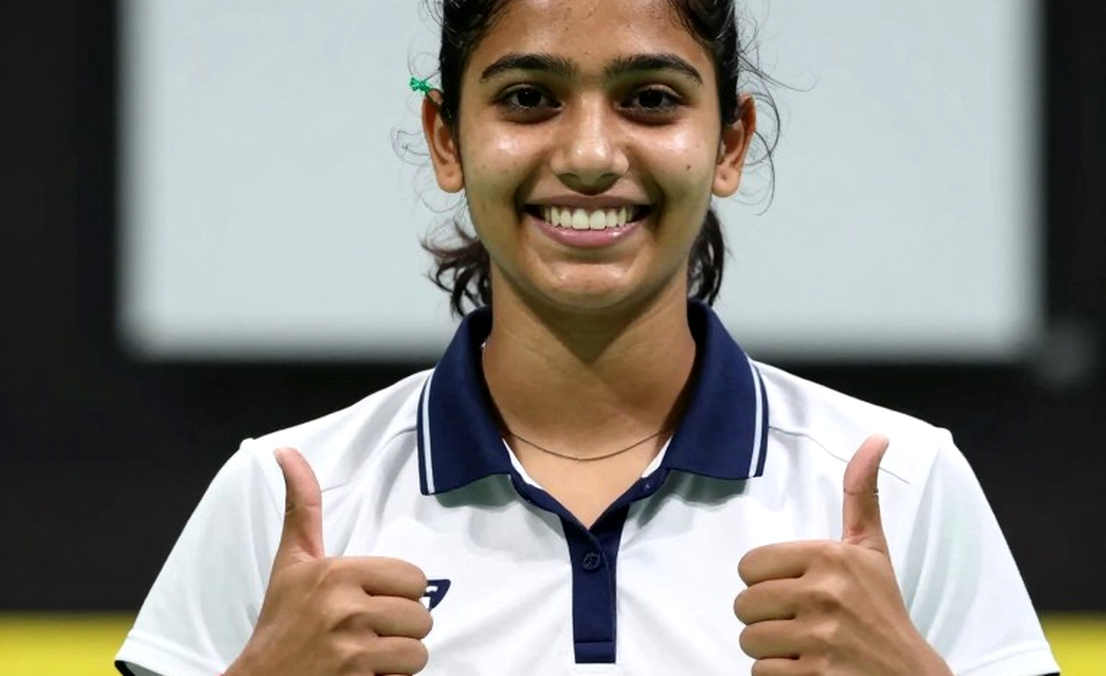
India's order of play holds no tactical surprise, but it reads well as a declaration of resources. First singles was PV Sindhu, a two-time Olympic medallist who has stood at the summit of world women's badminton for more than a decade. Second singles was Unnati Hooda. Third singles was Tanvi Sharma, seventeen years old, who had won the Chinese Taipei Open the previous month.
The result brooked no argument. Sindhu opened against Kamila Smagulova and won at a distance, one game closing at 21-9. Hooda overcame Alissa Kuleshova with games of 21-7 and 21-10. Sharma closed the tie against Diana Namenova, the first game drifting past comfortably and the second stopping at 21-10.
Three matches, three wins, and not one Kazakh game crossed the eleven-point mark. This is the kind of scoreline analysts call a class gap — a difference in level so wide that tactics are not required to explain it.
I have followed Asian women's badminton long enough to know that scorelines of this type carry almost no scouting value. They confirm what everyone knew before the first serve: India are stronger than Kazakhstan. They confirm nothing about the distance between India and China, Japan or South Korea — the teams they will have to meet if they want to go deep.
A sleepless Asian Games night, and I read their bodies like a map still being drawn.
What I actually read in a tie like this is not the scoreline but the structure of the line-up, because the line-up is where a coaching staff reveals what it believes about its own weaknesses. Three singles players were arranged in a fixed order: one veteran, then two youngsters. Two doubles pairs were named but given no minutes. That structure says more about how India sees itself than the 3-0 does.
Sindhu played the opening match, and her placement first is a convention of team badminton: put the most experienced player in the anchor slot to set the psychological tone for the whole side. But read through the language of physical load, it is also a decision about economy. A player who has accumulated more than a decade of top-level competition, with two Olympic medals in the collection, sits at a stage where every round adds to a physical debt that can never be fully repaid. Drawing a low-tier opponent is a chance to keep her moving lightly, not a chance to extract maximum output.
The body of an elite player is an account that carries interest. You do not withdraw capital in a match you know you will win.
The two young players sit on the opposite side of the curve. Hooda played the second match and won comfortably, a thin but correctly-directed data sample. Sharma is seventeen, has just taken her first international title in Chinese Taipei, and was handed the deciding match — a deliberate act of trust.
Put those three names together and you see a generational bridge: one anchor past her peak, two shoots not yet ripe. This construction is common in national teams, because it trades certainty at the top for exposure for the next cohort. But it also means that India today are still borrowing strength from a player whose career has already crossed to the far side of the slope.
And this is where the crack appears. India have long been known as a nation strong in singles and thin in doubles. In the tie against Kazakhstan, both Indian pairs — Treesa Jolly with Gayatri Gopichand Pullela, and Kavipriya Selvam with Simran Singhi — did not play a single point, because the tie had already ended at the third singles. The weakest part of the team structure had been concealed perfectly by the team format itself.
This is not a mistake by the coaching staff. In a tie already decided, keeping the doubles line-up intact is reasonable on physical grounds. But seen from the standpoint of data collection, the price is a blank space: India walk out of this tie with no additional information about how their doubles handle pressure.
A tournament does not create a crack; it only exposes cracks that were already there. The problem here is that the crack was not exposed. It remains in the box, waiting for a stronger opponent to open it.
One technical detail deserves attention: all three Indian singles matches finished in two games, none stretched to a decider. For a young player like Sharma, winning cleanly in two games against a weak opponent provides no test of how she handles being behind, or of how she copes when a match goes to a deciding game. That is the kind of data only a close contest can produce.
The status of the tournament needs to be stated clearly. The Asian Games is a continental multi-sport event, outside the World Tour system of the Badminton World Federation. Results here largely do not convert into BWF ranking points the way a World Tour event does. Its value lies in national prestige and in the opportunity to develop a squad, not in an individual's ranking trajectory.
That reframes the entire tie. A 3-0 win over Kazakhstan does not move Sindhu up any tier on the ranking table and does not open any seeding door for anyone. It has value in exactly two areas: internal confidence and competitive minutes for young players. In the second area, India got precisely what they needed.
On format, this is the crux. A five-match team tie carries far less randomness than an individual knockout draw. When the class gap is wide enough, the tie ends early, exactly as it did. A three-match tie is not a measure of India's absolute strength against medal contenders; it is a structural property of the format meeting a weak opponent.
One detail in the Sindhu data made me stop. A score of 7-2 appears in the record of her game. Under the current 21-point system, a game ends only when one side reaches 21, and if the sides are level at 20-20 the winner must lead by two, capped at 30. A 7-2 line does not correspond to a completed game. Most likely it is a mid-game score recorded as a game result, or a transcription error somewhere in the wire chain.
Data does not lie, but it knows how to hide the right questions. When an impossible value enters a results table, the correct response is not to ignore it but to trace it back to source. For this tie, I would cross-check the official organisers' results before using any scoreline for long-term analysis.
Place India on the map of Asian women's badminton and the picture remains fairly clear. China sit on the top tier with depth in both singles and doubles. Japan, South Korea, Indonesia and India itself form the group of direct chasers, each strong in a different segment. Thailand, Chinese Taipei, Malaysia and Hong Kong occupy the next layer. Kazakhstan sit lower still, and the source provides no baseline results for them to compare against.
On the Kazakh side, the source offers no ranking, recent form or head-to-head history for any of the three names Kamila Smagulova, Alissa Kuleshova and Diana Namenova. The absence of that data is itself information: it shows these are players who have never appeared in the statistical tables I normally use to build opponent profiles. When an opponent has no baseline data, every conclusion drawn from beating them must be downgraded in reliability.
The gap between India and the leading group lies mostly in the doubles. The strong Chinese and South Korean sides can rotate several pairs of comparable quality, while India load their weight onto singles players. So when assessing India's medal chances, I do not look at this 3-0. I look at how their doubles will respond in a tie where three singles matches are not enough to decide it.
If India want to reach a medal match, they will need a contingency for the scenario in which three singles do not deliver three points. That contingency can only come from the doubles, and the doubles are the only part of the line-up not battle-tested at these Games. This is the paradox of easy ties: they give you the win but take away the chance to test precisely where you most need testing.
The risk surface of this line-up has four points, none of which originate in the match just played. Physical load is concentrated on Sindhu in the first-singles anchor slot, and every hard tie must pass through her first. The doubles remain an unverified blank space, a point that can be exploited the moment India meet a doubles-strong nation. In the long term, if the next cohort does not arrive in time, the squad will face a vacuum at first singles within a few years. And in narrative terms, attaching a seventeen-year-old to the phrase "closing the distance to the podium" after a single mid-tier title is a form of pressure installed in advance.
This is where I want to go against the prevailing reading. When a team wins 3-0 without needing its doubles, most commentary calls that smart economy: saving troops for later rounds. That reading sounds reasonable, but it ignores the fact that the cost of testing the doubles in an already-secured tie is close to zero. You are not risking the outcome; you are only risking exposure of a weakness — and a weakness is always better exposed in the cheapest available laboratory.
A coaching staff does not rest a doubles pair; it stores risk still sealed in its box.
A second counter-reading: this 3-0 says nothing about India's medal chances, and domestic media elevating it into a symbol of a smooth campaign is a mismatch between expectation and evidence. The foundation of this victory is very thin: a low-tier opponent, a format that ends early, and a seventeen-year-old who has just won her first title. That is not yet enough to talk about a continental podium.
Going against the crowd does not mean denying everything. Sharma has a real foundation: seventeen years old, Chinese Taipei Open champion the previous month, handed the deciding match and unshaken. That is a signal worth tracking. But between "worth tracking" and "medal contender" lies a distance that must be measured by matches against top-class opposition, not by the mishit smashes of a lower-tier team.
What I am waiting for in India's next tie is not a different scoreline. I am waiting to see whether the coaching staff dare field the doubles in a tie already secured, and whether Sindhu is managed intelligently enough to keep her legs for the knockout rounds. A mature national team is measured by how it handles its own weak part, not by how it hides it.